

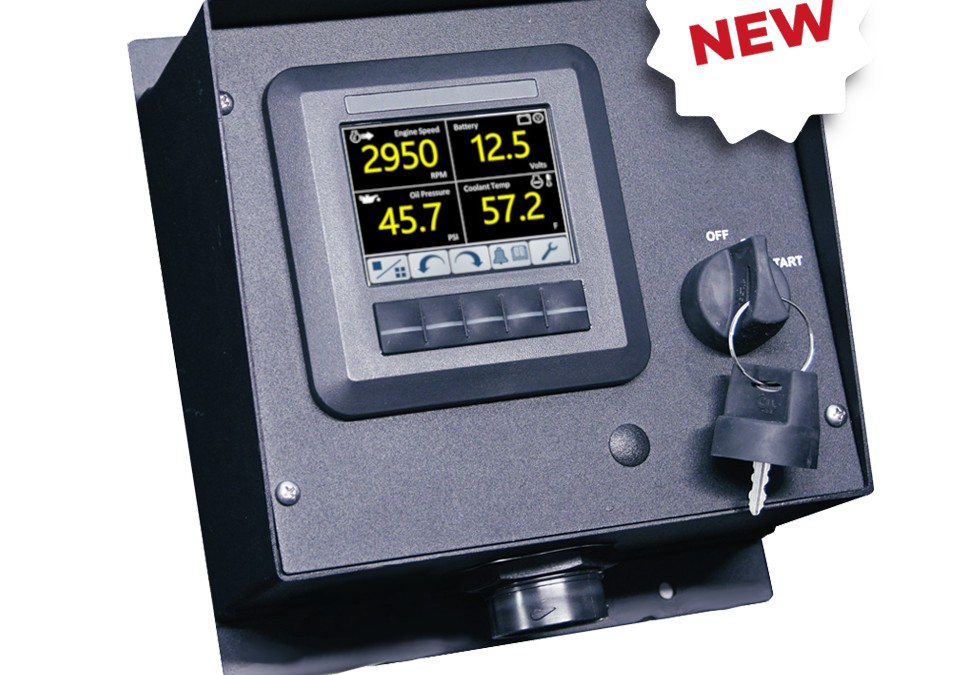
Troubleshooting electronic diesel engine controller issues begins with a structured review of power supply integrity, sensor inputs, wiring condition, and active or stored ECU fault codes (DTC’s). A logical diagnostic sequence prevents unnecessary component replacement and can help reduce downtime.
Electronic diesel engine controllers react strictly to the inputs they receive. When voltage, signal quality, or communication integrity falls outside expected parameters, the engine’s electronic control unit may limit fuel delivery, initiate reduced power mode, or activate protective engine shutdowns. These responses often appear to be controller failure but are frequently caused by external conditions.
This overview outlines common failure patterns and structured diagnostic principles used in industrial engine control systems.
Understanding How Diesel Controllers Fail
Controllers Depend on Clean Inputs
Modern engine control systems rely on stable voltage, accurate sensor data, and clean grounding. Issues with any of those can disrupt controller logic and trigger protective responses.
Controllers do not interpret intent, they process data. When inputs are incorrect, outputs follow accordingly.
Common Early Warning Signs
Control system instability often presents as intermittent stalling, unexpected derate conditions, delayed or absent throttle response, or active diagnostic trouble codes (DTCs). In many cases, these behaviors are not random failures, but protective strategies commanded by the engine ECU in response to sensor input faults, power supply irregularities, or communication errors, rather than internal controller failure.
These conditions may only appear under specific load, temperature, or vibration scenarios, making structured diagnostic testing essential.
Power and Ground Verification
Power Supply Integrity
Unstable or insufficient supply voltage is one of the most common contributors to unexpected control system behavior. Low battery voltage, alternator issues, voltage drop across connectors, or corroded terminals can prevent electronic control circuits from operating within their intended range.
Under-voltage conditions can produce erratic behavior that appears unrelated to power supply. Internal circuits may function inconsistently or not at all when voltage falls below design thresholds. In MBW’s display-based controllers, sustained voltage below approximately 7 volts (during engine crank, for instance) may cause the display to shut down entirely.
Voltage should be verified both at the battery and directly at the controller connector. A stable reading at the battery does not guarantee proper voltage at the module.
**Controller power and ground connections should be wired directly to the battery to minimize voltage drop and electrical noise.
Ground Integrity and Electrical Noise
Poor grounding can introduce electrical noise and unstable reference voltage to the control system. Loose ground connections, painted mounting surfaces, or shared grounding paths can disrupt signal integrity and cause unpredictable behavior.
Evaluating voltage drop during normal electrical operation provides a more accurate assessment of ground integrity than visual inspection alone.
Sensor Inputs and Signal Validation
Sensor Input Validation
Engine controllers depend on accurate sensor data for reliable operation. When sensor signals fall outside expected ranges due to degradation, wiring faults, or reference instability, the engine ECU may initiate derates or fallback strategies. Validating sensor data under normal operating conditions is essential before attributing faults to the controller.
Signal Integrity and Intermittent Faults
Connector wear, corrosion, or wiring defects can disrupt signal integrity without producing immediate or repeatable faults. These issues often appear only during vibration, temperature variation, or load changes, and may mimic controller malfunction even when the controller itself is functioning properly.
Software Considerations
Software and Configuration Alignment
Engine control software must match both the specific engine platform and the intended application. Using incorrect firmware versions or mismatched configuration settings can produce behavior that resembles hardware failure.
Verifying that the installed software version and application configuration align with the engine and system requirements should precede component replacement.
Fault Code Interpretation
Fault codes identify affected circuits, not necessarily failed components. Replacing parts based solely on codes can lead to repeated service events.
Cross-reference codes with live data and operating conditions to determine root cause. In electronically controlled diesel systems, diagnostic trouble codes (DTCs) are generated by the engine’s ECU, not the display interface. When DTCs are active or stored, they originate from the engine controller itself.
Environmental and System-Level Influences
Environmental and Mechanical Influences
Electronic control systems operate in environments subject to heat, vibration, and contamination. Over time, excessive thermal exposure, mechanical stress, or fluid intrusion can affect surrounding wiring, connectors, and mounting integrity.
Repeated or intermittent issues should prompt evaluation of installation environment and mechanical support conditions, not solely the controller itself.
Interaction with Other Engine Systems
Electronic diesel engine controllers operate within a broader engine control architecture. Fuel delivery systems, air management components, aftertreatment systems, and CAN Bus communication networks can all influence system behavior.
A fault in one subsystem can produce symptoms that appear to originate from the display, even when the display itself is functioning as intended. Evaluating system-level interactions is essential before isolating a single component.
When to Consider Controller-Level Issues
After verifying power, inputs, software configuration, and system interactions, persistent internal fault indications may indicate a controller-level issue. Confirming external conditions first helps prevent unnecessary hardware replacement.
Final Thoughts
Effective troubleshooting of electronic diesel engine controller issues requires structured analysis rather than assumption. Verifying power integrity, sensor inputs, software configuration, and system-level interactions before replacing hardware reduces unnecessary downtime and repeat service events.
Understanding how electronic diesel engine controllers process and respond to input data allows technicians and integrators to diagnose issues more accurately and maintain reliable operation.
For OEMs and system integrators evaluating diesel engine control system behavior, MBW Technologies provides engineering expertise focused on system design, integration, and long-term reliability.